Marketing Is Behavioral Psychology With a Revenue Goal

KEY POINTS:
Human beings are complicated. Marketing has to account for that.
Good marketing doesn't manufacture a need. It meets one.
Your job isn't to implant the desire. Your job is to understand the person experiencing it.
SEO gets a lot more interesting when you stop looking at keywords and start looking at the person behind them.
Beautiful helps. Understanding converts.
Marketing is about understanding what happens between attention and action.
Strip away the campaigns, funnels, content calendars, ad platforms, acronyms and whatever new marketing term LinkedIn has collectively decided to abuse this week. Marketing is really about one thing: Understanding what makes people do things.
More specifically: what makes the right person notice something, care about it, trust it, remember it and eventually act on it. Which makes marketing, at its core, behavioral psychology with a revenue goal.
That sounds considerably more sinister than “we make Instagram posts,” but stay with me.
Good marketing isn't about tricking people into buying something they don't want. It's about understanding human behavior well enough to connect someone who has a problem with something that can genuinely help solve it.
The business gets a customer
The customer gets value
Everybody goes home happy. Ideally
Marketing starts long before someone buys
Think about everything that has to happen before a person becomes a customer.
They have to:
Notice you.
Recognize that what you're talking about is relevant to them.
Understand what you do.
Believe that you understand their problem.
Trust that you're capable of solving it.
Decide the potential benefit outweighs the cost, effort or risk.
And then actually do something.
Click
Call
Book
Buy
Submit the form
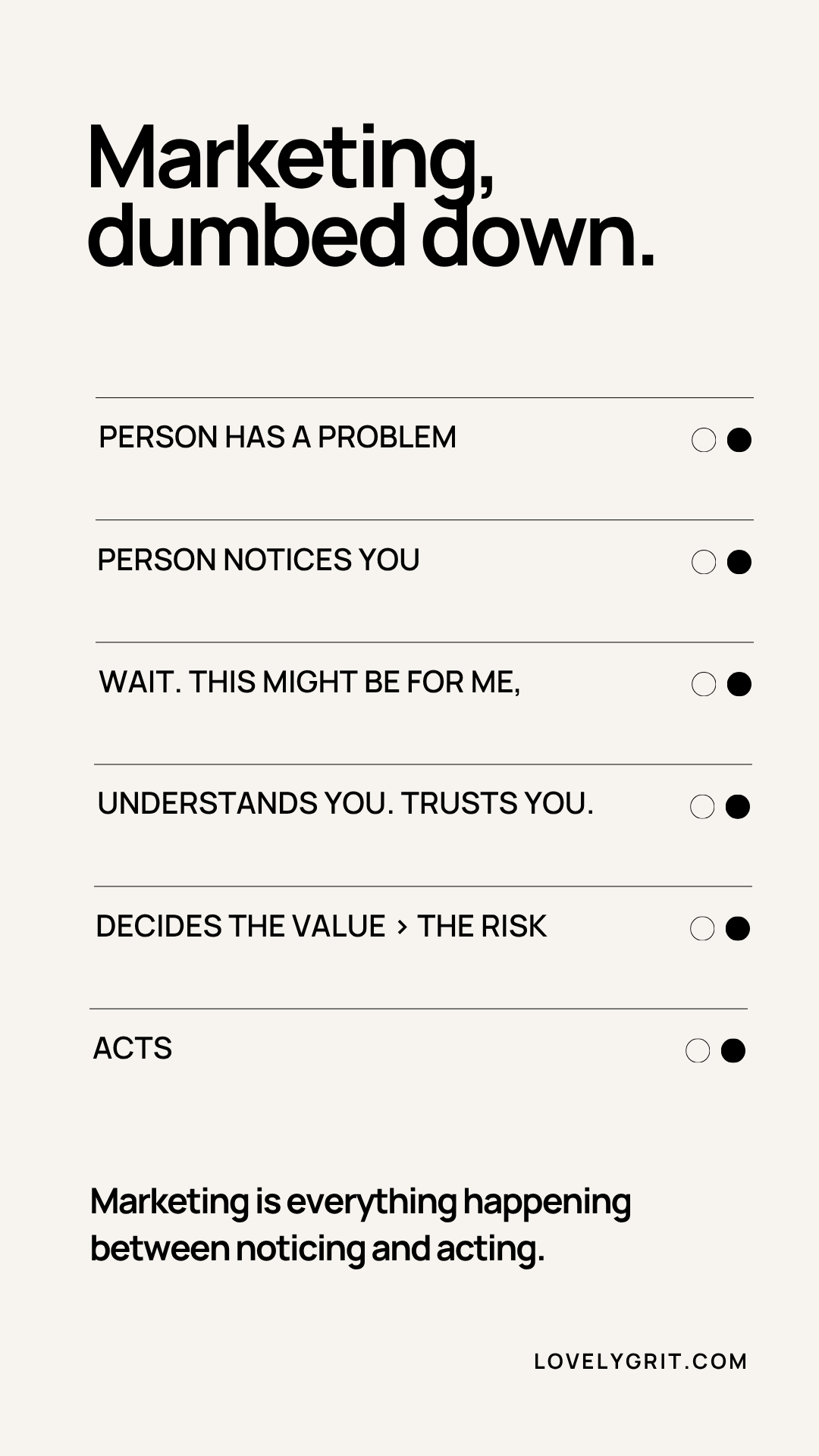
Those aren't just marketing steps. They're human decisions. And human decisions are messy. We aren't tiny rational calculators walking around carefully comparing every available option before selecting the mathematically optimal one.
Being humans means:
We skim
We make assumptions
We look for shortcuts
We notice certain things and completely ignore others
We trust familiar things
We look to other people for reassurance
We avoid things that feel confusing
We hesitate when something feels risky
We choose the thing that feels easiest to understand
And sometimes we choose the toothpaste because the box looked nice
Human beings are complicated. Marketing has to account for that.
The psychology is hiding in plain sight
Once you start looking for it, psychology is everywhere in marketing.
A headline tells someone whether they should keep reading
A testimonial makes a decision feel less risky
A familiar brand makes a new product feel safer
A clear pricing structure reduces uncertainty
A good call-to-action removes the question of what someone should do next
A well-organized website reduces cognitive load
An email subject line creates curiosity
A brand voice creates familiarity
Even the order in which information appears matters. That's not accidental. It's behavioral design. You're creating an environment that makes information easier to process and decisions easier to make.
And importantly, you're doing it without needing someone to consciously think:
Ah yes. This brand has successfully reduced my perceived risk while increasing cognitive fluency. I shall now proceed to checkout.
Their brain just goes: Yep. This makes sense. That's usually the goal.
Good marketing doesn't manufacture a need. It meets one.
This is where marketing sometimes gets a bad reputation. People hear words like persuasion, influence and consumer psychology and immediately picture someone rubbing their hands together in a dark conference room trying to figure out how to convince Grandma to buy six air fryers.
That certainly exists. It's also bad marketing. Sustainable marketing isn't about forcing a fit where one doesn't exist. It's about making an existing fit easier to recognize.
Someone is already frustrated with their website
Someone already needs a therapist
Someone already has knee pain
Someone already wants better accounting software
Someone already wants shoes that don't destroy their feet after three miles
Your job isn't to implant the desire. Your job is to understand the person experiencing it.
What are they searching for?
What matters to them?
What are they nervous about?
What have they already tried?
What would make them trust one option over another?
What information do they need before making a decision?
Good marketing doesn't convince the wrong person to say yes. It helps the right person get to an informed yes faster. There is a difference. A pretty important one.
Search is psychology, too
SEO is a perfect example. It gets reduced to keywords constantly. Put this phrase here. Mention that phrase three times. Write a blog. Hope Google smiles upon you. But a keyword is really evidence of a person doing something.
Someone searching: therapist near me is in a very different place than someone searching: why do I feel anxious for no reason
And that person is in a different place from someone searching: EMDR therapist for panic attacks.
Technically, those are keywords. Strategically, they're clues. They tell you something about awareness.
Intent
Urgency
Knowledge
Readiness
Fear
The question isn't only What keyword do we want to rank for?
It's: Who is behind that search, and what do they need from us right now?
SEO gets a lot more interesting when you stop looking at keywords and start looking at the person behind them.
Your website is doing behavioral work, too
The same thing happens in web design. A website isn't simply a container where you put your logo, biography, services and a button that says CONTACT. At least, it shouldn't be.
Every page is moving someone through a series of micro-decisions.
Am I in the right place?
Is this relevant to me?
Do I understand what they do?
Do I like this?
Do I trust this?
Can they help someone like me?
How does this work?
What will it cost?
What happens if I click this button?
That's why strategy has to come before decoration. You can have the most beautiful website on the internet and still lose someone because the headline is vague, the navigation is overwhelming and they cannot figure out what the hell you actually do.
Beautiful helps. Understanding converts.
Attention isn't the end goal
Marketing loves attention. Views. Likes. Clicks. Reach. Impressions. All useful metrics.
But attention by itself isn't particularly valuable.
A million people seeing something they don't care about doesn't beat 100 of the right people understanding exactly why they need it.
Marketing isn't about getting attention. It's about understanding what happens between attention and action. That's the part I find interesting.
Why did someone stop?
Why did they keep reading?
Why did they trust that statement?
Why did they hesitate?
Why did they choose this option instead of that one?
Why did they leave?
Those questions sit at the intersection of psychology and strategy. And answering them is what turns marketing from “making stuff” into actual marketing.
Psychology with a purpose
Ultimately, businesses don't market because understanding human behavior is intellectually fascinating. Although, frankly, it is. They market because they need people to act. Revenue is the business outcome. But the best marketing works because there's value on both sides of that transaction.
A business finds the person it can help
A person finds the business that can help them
Marketing simply shortens the distance between the two
So yes: Marketing is behavioral psychology with a revenue goal. Not because people are pawns to be manipulated. Because businesses are run by people. Customers are people.
And if you want one group of people to understand, trust and ultimately choose another group of people? You should probably understand how people work.
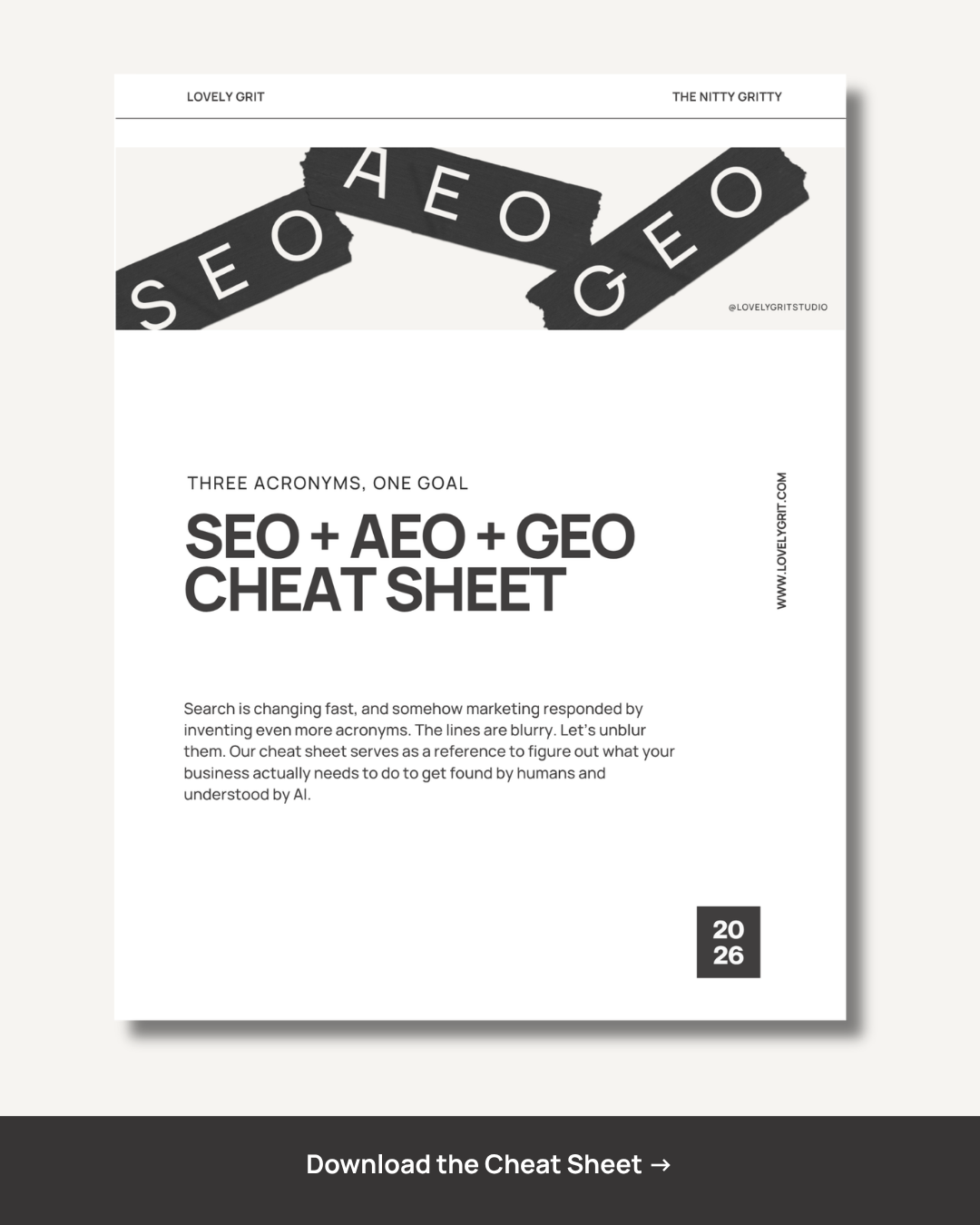
WANT THE CHEAT SHEET?
Drop your email below and I’ll send you the free one-page guide to SEO, AEO + GEO — without the marketing word salad.

YOU’VE GOT THE EXPERTISELET'S MAKE SURE YOUR MARKETING LOOKS LIKE IT.
I’m Samantha, founder and strategist behind Lovely Grit. I help health, wellness + expert-led brands turn what they know into websites, search strategies and marketing that gets them found, trusted + chosen.
If you’ve made it this far, you probably already know something in your marketing could be working harder. Let’s figure out what.